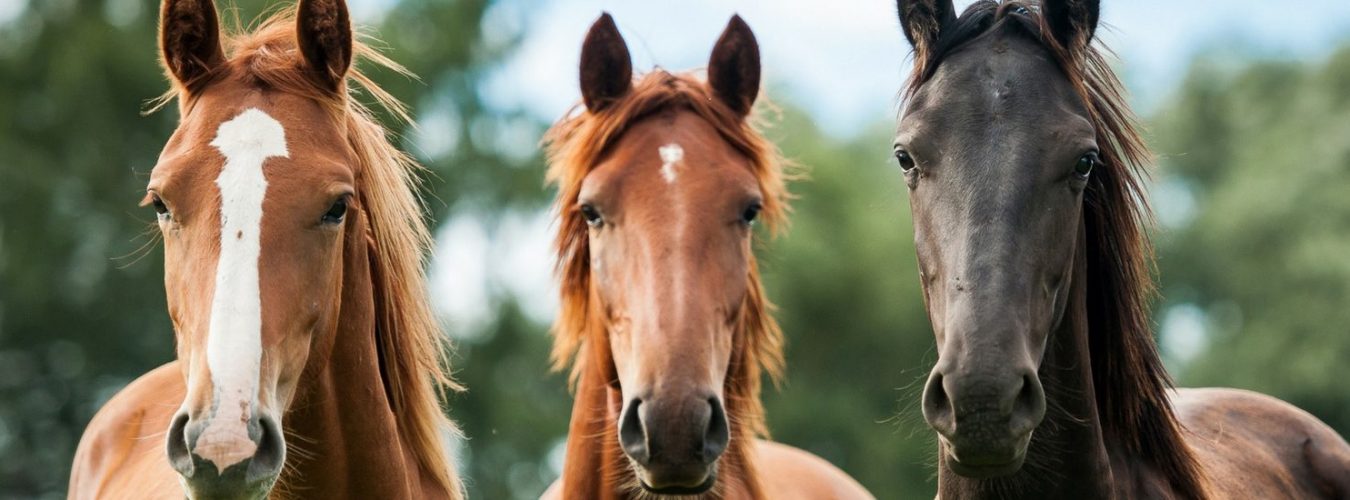
At some point, in my early 20’s, I started to question the manner in which we train our horses and what this means in terms of how this field evolved, or, rather, stagnated, for thousands of years. Traditionally, training involved (and, for the most part, continues to involve) dominance and negative reinforcement based methods, all of which result in the horse complying with requests in order to avoid a human induced “pressure” (a word used to describe both actual pressure – the leg, and pain – the bit, spur, crop).
There was a time, sadly not that long ago, when humans thought we were the only creatures capable of reason, of feeling emotions, and even pain (the latter being the most preposterous of all the things we told ourselves in order to justify our selfish behaviours toward animals). As time went on, even before the scientific method took hold nearly a century ago, some researchers began to question these baseless assumptions, and, as of late, turn them on their collective heads.
Today, we have a fair amount of understanding and, most importantly, scientific evidence, of animals sharing these abilities with us, even in the “smarts” department, although, we still top the figurative pyramid of cognitive skills, despite many self defeating attitudes we still share as a species.
Different brains, different perceptions
Humans, and a host of other mammals, have a prefrontal cortex. This is an area of the brain responsible, among other things, for complex emotions (intricacies of love, hate, friendship, the ability to predict the state of mind of another being) and rational thought (understanding and deducing cause and effect, planning, and putting information together to solve problems). It comes as no surprise that the prefrontal cortex is most highly developed in humans, though, far from perfect, as it can, and often does, lead us astray.
While relative brain size is not necessarily indicative of an animal’s ability to use information to reach a desired result (i.e. intelligence), the size of the prefrontal cortex (as a percentage of total brain mass) does matter.
Dogs, for instance, are more teachable than cats, and can form deeper, more meaningful emotional bonds with each other and humans. This is no small part due to the ratio of their prefrontal cortex to the rest of the brain being more than double that of felines. Similarly, chimps, are more intelligent than dogs, because, again, their prefrontal cortex is significantly larger.

It matters, but it is not the end-all of processing power. Environmental pressures play a major role in the development of cognitive tools necessary for making sense of the world we all share. For example, despite their tested ability to reason better than dogs, chimps fail certain cognitive tests that dogs pass with flying colours.
One such example is the bucket test.
Researchers seated a number of humans in a room with bowls of food on their laps and empty buckets at their sides on the floor. Then, they brought in an equal number of dogs and seated them in front of the humans. Once the dogs realized there was food to be had, they began to beg for it, as one would expect they would. Next, half the humans were asked to place the buckets on their own heads. The dogs, upon realizing these humans can no longer see them, stood up and moved to sit in front of humans without buckets on their heads and resumed begging.
In contrast, when this experiment was performed with chimps, the chimps stayed put and continued to beg for food from humans who were wearing the buckets on their heads and could not possibly see them.
Chimps, although they have the ability to imagine what another chimp (or person) is thinking and experiencing, did not make use of the information in this case. The dogs, who have a very limited ability to do the same, used the information to change their behaviours and get the food they desired. Wielding better processing equipment, as evident in this case, does not necessarily produce better outcomes. We can over-think a situation and get lost in the proverbial weeds (assuming this is what was happening during the experiment).
Horses, like many other animals, do not have a prefrontal cortex at all, which raises the question, how do they learn and make decisions without it?
Before we jump the gun and decide they must lack intelligence, we need to understand that animals without a prefrontal cortex have evolved alternative pathways to make sense of their world. Although the equipment to understand certain things is missing, some animals have solved problems that astonished even the researchers who observe them on a regular basis. For instance, although birds do not possess a prefrontal cortex, some species are capable of solving complex puzzles, to reach morsels of food. The puzzles would trip up most human school age children, but the birds figure them out surprisingly fast.
For many animals, adaptation to their environments, and, thus, survival of their species’, does not require forming complex relationships in order to successfully reproduce and pass on their genes. Cats, for example, are solitary animals, and, as such, do not require companionship to survive or be content. Dogs, on the other hand, are social animals who depend on the pack working together to avoid danger and be able to find food. In order to do these things, their brains evolved to make sense of complex information, social cues, and have the ability to show and understand intent (feral dogs share and trade responsibilities as needed, taking on various roles from hunter, to navigator, to babysitter). Furthermore, a solitary dog, is an unhappy, fearful dog.
Horses, unlike cats and dogs, are prey animals who depend on group dynamics and social interactions to survive. A solitary horse has a very low chance of survival in the wild, same as a dog. Both species must be able to navigate social cues and form relationships to be successful. Prey animals run first, ask questions later. If unable to run, they fight. If a horse deems a situation to be dangerous or frightening, s/he will do whatever necessary to break free and run. Fleeing, however, is their second line of defence. The first is silent communication within the herd. Cues and messages that to us, humans, look like nothing more than mindless, reflexive movements, are, in fact, a sophisticated form of communication within the herd that takes place without interruption, for the entirety of the horse’s life. Aware of each horse in its social radius, the individual, and the herd as a whole, will react almost instantly to any danger cue produced by a member of the group. The entire herd will bolt and run from danger as soon as one member gives the signal, which itself is usually silent. Similarly, cues of calmness will spread through the group and produce a relaxed state for all.
In connection training, we often say that horses are always listening but are, themselves, rarely heard. They are constantly communicating with us, but we are oblivious, because the communication is non-verbal. This way of communicating, however, is by no means simplistic. It is rich with information and nuance, ripe for the picking, if only we will pause and take it all in as it is offered.